
Feedback from first 6 Courses
Latest News
Stay up to date with the latest news from the ERIS project. In this section, you’ll find updates on our training activities, research developments, upcoming events, and key milestones achieved by the ERIS network. Discover how our partners across Europe are working together to advance simulation-based education and innovation in electrophysiology.
Six courses, three cities, 52 Cardiologists and cardiac surgeons: what participants told us about the ERIS 2026 programme

ERIS programme returns a recommendation score of 94.3 out of 100, unanimous agreement on the value of peer exchange, and not one respondent reporting that they left without substantial new knowledge. From October, successful completion will also carry university credit.
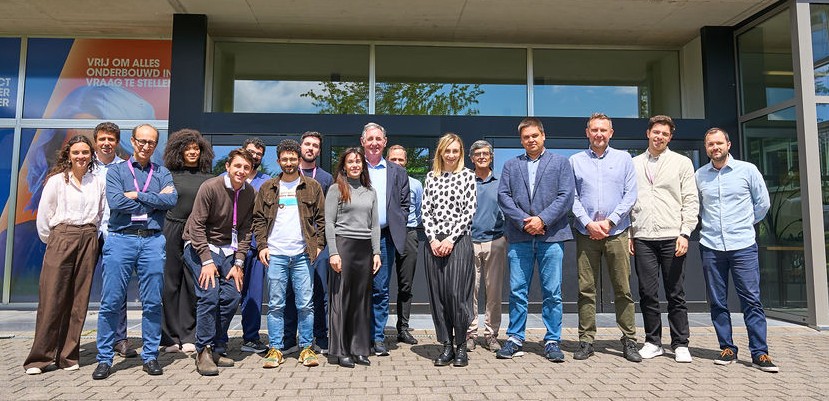
Between April and June 2026, the European Research Institute on Simulation (ERIS) delivered six advanced electrophysiology courses across Barcelona, Brussels and Toulouse, covering left bundle branch area pacing, hybrid ablation, leadless pacing, subcutaneous ICD implantation, pulsed field ablation for atrial fibrillation, and 3D mapping. Fifty-two practising Cardiologists and cardiac surgeons took part, and 41 of them, a response rate of 79%, completed the standardised post-course evaluation.
The headline figures
- An average recommendation score of 94.3 out of 100, with 95% rating the overall quality of the course highly and 95% agreeing that it met its stated objectives.
- 100% found the exchange of experience with peers valuable. Our courses are deliberately small, typically fewer than ten participants, and that unanimity suggests the constraint is doing real work.
- Six in ten respondent reported that more than half of the course content was new to them, in an audience already performing these procedures.
- 93% reported that their technical skills had improved and 90% agreed the course would help improve patient outcomes.
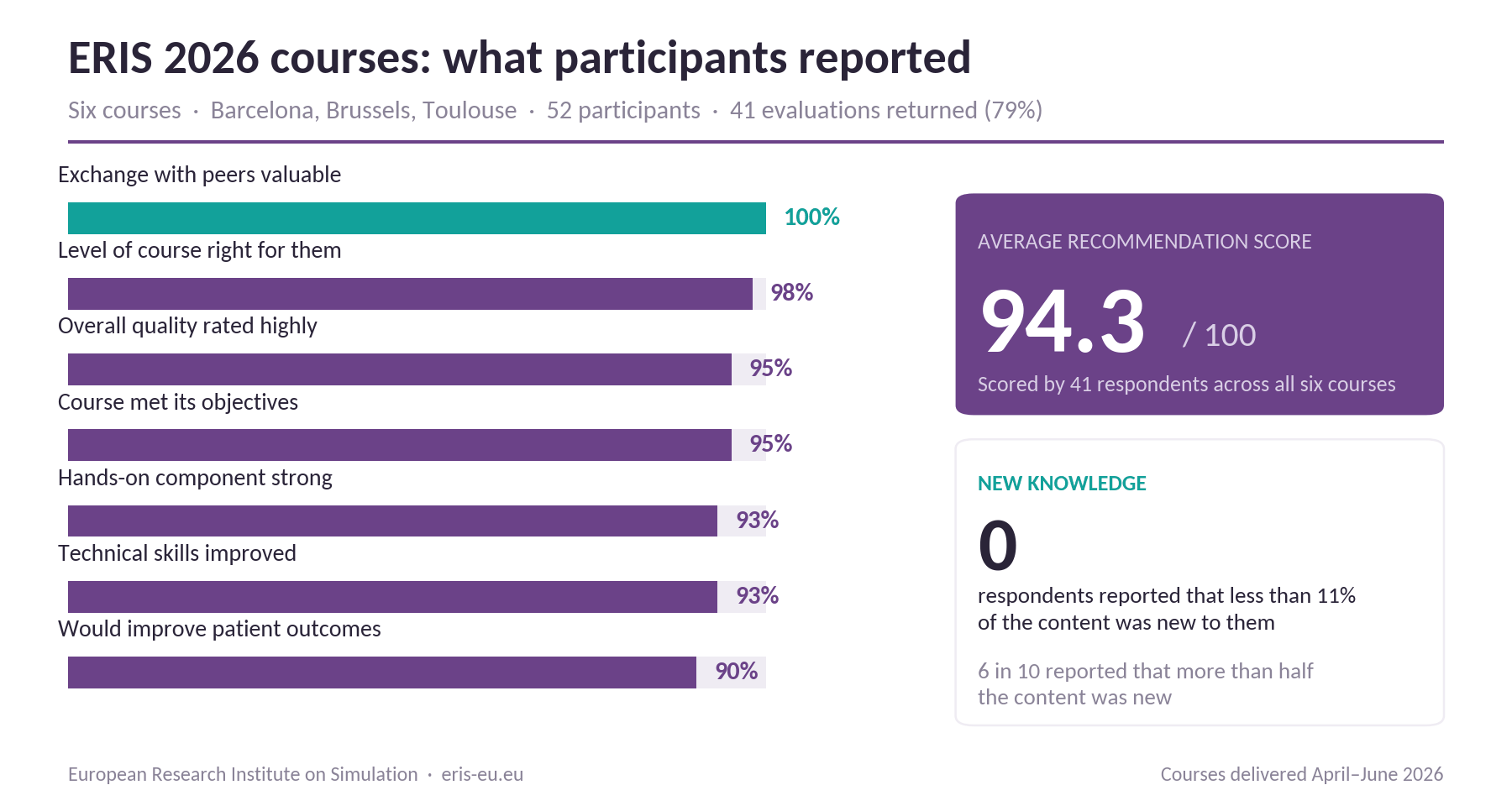
The three-day format was appreciated, and 98% judged the level of the course right for them. We will keep that structure for the 2026 to 2027 cycle while giving progressively more of it to the simulation stations.
From satisfaction to certification
Participant satisfaction tells us that a course was well received. It does not tell a hospital, a training programme director or a national authority that a physician has demonstrated competence. Closing that gap is why our courses are built on Proficiency-Based Progression, an approach in which participants advance by meeting objectively defined performance benchmarks rather than by completing an agenda.
That work reaches a milestone this autumn. In October 2026, participants completing the ERIS programme on Pulsed Field Ablation for Atrial Fibrillation and Intracardiac Echocardiography at the Vrije Universiteit Brussel will receive an official university certificate carrying 3 ECTS credits. In December 2026, participants completing the ERIS programme on Leadless Pacing at Hospital Sant Pau will receive an official university certificate, carrying 3 ECTS credits. A microcredential of this kind is portable, verifiable and recognised by institutions that have never heard of the course a physician attended. We will publish more on what it involves over the coming weeks.
For our partners
To the industry partners who have supported these six courses, the figures above are yours as much as ours. Training that participants rate at 94.3 out of 100, and that demonstrably teaches experienced operators something new is remarkably rewarding, and everyone who participated—the faculties, as well as the teams from each partner company deserves our heartfelt thanks for this excellent achievement.
If your organisation is considering how to support advanced electrophysiology training in 2027, or you would like to be notified when places open, we would be glad to hear from you.
Contact: info@eris-eu.eu
Website: https://eris-eu.eu/